

Song of Nanzhao
Cultural Music-Driven Puzzle Game
Lead Game Designer, Technical Designer, Producer

My Contributions
Technical Game Design - Design game mechanics and game systems; scripted AI behaviors, cutscene elements, UI menus, and game progression system.
Level Design - Designed 2 top-down music-driven puzzle levels (~25 minutes of gameplay).
Quest Design - Created 4 parallel missions combining collection, puzzles, and NPC-driven interactions.
Narrative Design - Developed narratives and branching dialogue systems for 23 unique NPCs.
Production - Led a multidisciplinary team over 4 months, managing tasks, playtesting, presentations, and game publishing.
Game Capture & Content Creation - Directed cinematic capture in UE5; edited trailers; created production materials, screenshots, and graphics.
A music-driven puzzle game slice inspired by Chinese folk music from historical periods. Let music guide your path, and experience a story of music and peace.
Genres
Puzzle
Narrative
Top-Down
Music
Single-Player
History
Duration
Team
Tools
Platform
4 Months
6 Members


Overview
Links


Level & Quest Design


A town map featuring a villager's living area, the market area, and goat pen, and the surrounding natural environment. In the level, the player will finish the tutorial and several parallel missions.

Sample One-Page Mission Design
Narrative Design
Narrative Goals & Player Experience
Narrative Context
This level serves as the 1st chapter of the story. The player arrives in a border village of Nanzhao during wartime, searching for the renowned guzheng maker said to live there. The village context emphasizes tension and uncertainty, setting the stage for building trust and cultural exchange through music.
Design Goal – Emotional Experience
-
Alienation to Belonging: Players begin tense and distant from the village, and gradually feel recognized, respected, and connected to the world.
-
Curiosity to Empowerment: Through music mechanics and NPC interactions, players move from simple curiosity to a sense of mastery and confidence.
-
Connection to Nostalgia: By the end, players feel emotional closure and a bittersweet reluctance to leave, carrying hope and a lingering attachment to the place.

Narrative Structure & Player Progression
Narrative progression is driven through system-based interaction, encouraging players to actively approach NPCs and explore the surrounding environment rather than passively consuming story content.
Narrative Layers
-
Explicit Narrative
Delivered through mission progression, dialogues, and cutscenes, establishing core story beats and chapter structure. -
Implicit Narrative
Communicated through environmental storytelling, such as the war-torn village setting, grieving villagers, and visual cues surrounding loss and conflict. -
Emergent Narrative
Optional interactions with world NPCs provide additional background context and side character stories, rewarding player curiosity without blocking progression.
Narrative Flow
Narrative delivery follows a structured sequence aligned with player progression and gameplay flow:
-
2D Cutscene (Intro)
Introduces historical and cultural context, establishes player identity, and sets the narrative motivation for entering the village. -
Dialogues (Missions & Exploration)
Players unlock narrative information by engaging with mission-critical NPCs and optional world characters while exploring the environment. -
2D Cutscene (Outro)
Concludes the chapter with narrative resolution and foreshadows the next chapter’s story arc.

Design Methodology & Pipeline
When designing characters and dialogue, the narrative process was guided by three core questions:
-
Historical Context: What behavior, language, or reaction would make sense within the real historical and cultural setting?
-
Gameplay Function: What functional role does this NPC serve in mission progression, navigation, or world readability?
-
Narrative Value: What unique information, emotion, or perspective does this character communicate to the player?
1. Definition
Two core NPC categories were established early to support both progression and narrative depth:
-
Mission-Critical NPCs
Required for advancing gameplay and main narrative beats. -
World-Enriching NPCs
Optional characters that expand lore, emotional context, and cultural atmosphere.
For each NPC, purpose, spawn location, and dependency on player progress were clearly defined.

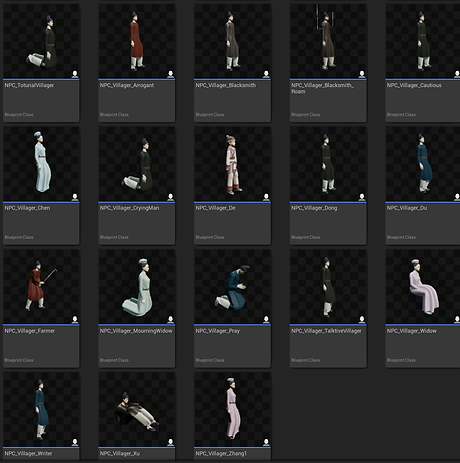
Mission-Critical NPCs – Essential for progressing the main questline. Players must speak to them to receive key information, unlock objectives, or trigger major events.
World-Enriching NPCs – Deepen the narrative and atmosphere. While not required to complete missions, interacting with them reveals cultural background, personal stories, or environmental lore.
2. Character Creation
-
Designed each character’s identity:
-
Personality, role, game state behaviors, player interactions, animation states, and dialogue framework.
-
This ensured narrative consistency across gameplay, dialogue, and presentation.
4. Translation
English localization focused on maintaining the emotional intent and pacing of the original Mandarin dialogue, with AI-assisted refinement used to support consistency while preserving authorial tone.
3. Writing
All dialogue was initially written in Mandarin to preserve cultural authenticity, tonal nuance, and linguistic rhythm aligned with the historical setting.
5. Implementation
Narrative systems were implemented directly in Unreal Engine 5:
-
NPC Blueprints and dialogue trees
-
State-driven behavior logic
-
Animation blendspaces tied to interaction states
NPCs were then placed in-world for in-engine testing, allowing iterative validation of pacing, clarity, and visual presence.
Production
Project Scope & Constraints
-
Team Size: 6 members
Production Period: 4 months (academic production, vertical slice) -
Developed under limited engineering bandwidth, with programmers using Unreal Engine 5 for the first time.
-
Strong emphasis on cultural authenticity and systemic narrative design, which required close alignment between design intent and technical feasibility.
Production Strategy & Coordination
-
Served as Lead Designer and Producer, responsible for guiding design direction while managing scope, technical risk, and team capacity.
-
Adopted a rapid prototyping strategy early in production to validate core gameplay and puzzle systems before expanding content.
-
Support engineering onboarding, allowing programmers to ramp up in Unreal Engine 5 workflows during the first several weeks while designers iterated on playable prototypes.
-
To control scope under art and time constraints, asset production was prioritized for core characters and major architectural elements, while background environments leveraged curated third-party assets.


Early Planning Boards
Milestones & Iterative Development
Project & Task Management
-
The project followed an Agile, milestone-driven workflow, with day-to-day work managed through a Kanban-style task board to support continuous iteration across design, programming, art, and audio.
-
Each milestone functioned as a decision checkpoint to validate gameplay mechanics, narrative clarity, and technical feasibility before expanding scope.
-
Weekly progress was documented through project blog posts on the project website.

Trello Task Management Boards

Milestones & Timelines
Scope Control & Trade-offs
Several originally planned mechanics and level variations were scoped down, merged, or removed as technical constraints and playtests revealed increasing cognitive load and implementation risk. Rather than pursuing feature breadth, success was redefined around clarity, system legibility, and player comprehension.
Key Trade-offs & Decisions
-
Week 7 -Prototype Reassessment
-
Early prototypes failed to demonstrate the intended gameplay potential within the available timeframe. Technical friction in Unreal Engine, particularly around 2D-style mechanics and unstable player controls, introduced high iteration cost and risk.
-
Decision: Reduced multiple puzzle solution paths to a single, clearly readable interaction and shifted visual direction from pure 2D to a 2.5D stylized approach, improving technical stability and player control.
-
-
Week 10 - Scope Reduction
-
The rosewood minigame increased art production time without meaningfully reinforcing the core cultural narrative.
-
Decision: Removed the minigame and replaced it with a simpler, time-limited music puzzle in the main scene, reinforcing the primary mechanic while reducing complexity.
-


2D to 2.5D
Playtesting & Feedback Integration
Playtesting was conducted throughout production using short, frequent sessions and milestone-based larger tests, allowing feedback to directly inform design and scope decisions.
Playtest Structure & Participants
-
Bi-weekly Tests
Short playtest sessions with 3–5 players every two weeks, focused on validating mechanics clarity and moment-to-moment comprehension. -
Mid-Production Playtest Event
A larger playtest with 24–30 participants, primarily from the target audience, used to evaluate in detail metrics. -
Mid–Final Target Audience Testing
High school students playtested the game 6 sessions per week over two weeks, providing insight into learnability and onboarding effectiveness. -
Final Faculty Review
Final evaluation with 15 adult faculty members, focused on overall clarity, pacing, and presentation quality.


Post-Playtesting Questionnaire
Feedback Integration
Playtest results were consolidated into structured playtest notes and categorized across key areas by the production team.
High-impact feedback was then reviewed, prioritized, and translated into actionable tasks using a Trello-based Kanban workflow.

Playtest Results Visual Summary
Evaluation Metrics
Feedback was gathered using a structured post-playtest questionnaire and qualitative observation, focusing on:
-
Clarity of Objectives – Did players understand what to do and why?
-
Flute Mechanics – Ease of learning, usability, and perceived expressive range
-
Engagement – Overall interest and emotional involvement
-
Story & Cultural Communication – Effectiveness in conveying historical themes and cultural context


Playtest Doc
Delivery & Outcomes
The final build successfully met its design and production goals, supported by playtesting data and consistently positive feedback from instructors and reviewers.
The project was published on itch.io and Steam. I led external outreach to potential publishers and owned the creation and coordination of all promotional materials, including the game trailer, visual assets, and store page graphics.
For a more detailed breakdown of challenges, decisions, and lessons learned, see the full project post-mortem.

Score Improvement & High Final Scores for All Metrics